What does Avocado AI do that MakeUGC does not?
Each row is a capability teams cite when they move off MakeUGC. The left column is the difference, the right column is what it changes in day-to-day ad production.
| Difference | Why it matters |
|---|---|
| AI UGC inside a full brand workspace | The UGC studio sits next to the image, video and audio workbenches on one credit balance. Talking head plus cinematic product shot from one workspace. |
| Your real product in the creator's hand | Avocado edits the creator look with GPT Image 2.5 Flare so the actor holds your actual product, then animates it. Brand DNA keeps products, references and tone on every run. |
| Ready creator looks or your own | Start from a ready creator look or use your own, pick one of four engines, and pair it with Fish Audio S2 Pro voices, voice design or a cloned brand voice. |
| Video models for the cuts around UGC | Seedance 2.5 for pack shots, Kling 3.0 for stylized social, Veo 3.1 for brand films with native audio, and MiniMax H3 MAX for fast cuts up to 1080p. |
| Voice, music, and finishing in one place | Audio Studio covers voices, music beds and sound effects. Director mode in Flows assembles the cut with music on a timeline. No separate voice app, music app or editor. |
| Flows you build once and run again | Founder, designer and paid acquisition lead work on one canvas with real-time collaboration and comments, then rerun the same Flow for the next product. |
How do I move from MakeUGC to Avocado AI?
Migration takes 4 steps and no export tooling: your product photos and brand assets are the only inputs Avocado AI needs.
- 01Day one, set up Brand DNA: upload product photos, reference images, tone and rules, and save each product so it can be reused in images, video and UGC.
- 02Day two, open the UGC studio, pick a ready creator look or use your own, attach the product so the actor holds it, and generate five variants from different scripts.
- 03Day three, add the cinematic pack shot with Seedance 2.5 and the stylized social cut with Kling 3.0, then create a voiceover and a music bed in the Audio Studio.
- 04Day four, put the pieces in a Flow, switch to Director mode to assemble the cut with music, and share the Flow with the team for comments and sign-off.
MakeUGC sits in the AI UGC ad category alongside Arcads, Creatify, and Captions. The product is honest about its lane: avatars, scripts, talking-head clips, fast iteration, hook templates that make it easy to produce ten variants in an afternoon. For a brand testing AI UGC for the first time, MakeUGC gets you to first variants quickly. The disagreement is what happens when the brand needs the product in the clip to match the bottle on the shelf, the cinematic pack shot to come from the same workspace, and the team to align in one place.
The single biggest unlock for AI UGC ad performance is consistent product identity across the entire variant set. Avatar fidelity matters; product fidelity matters more for a brand at seven figures, because when the creator holds up the product or the clip cuts to a hero shot, the bottle has to match every other piece of the campaign. A tool built around the avatar treats the product as an afterthought.
AI UGC inside Avocado, alongside everything else
Avocado is one creative system with three ways to work: Studio, where you make it, Flows, where you repeat it, and Super Agent, where Avo does it for you. The UGC studio is one of four Studio workbenches, next to image, video and audio, on one credit balance and one library.
You write a script and get a talking video in 9:16, 1:1 or 16:9, up to 30 seconds. The engine is your choice per ad. Fast UGC is the default, on Happy Horse 1.1, for 5 to 15 second clips at 720p or 1080p. Talking head pairs Fabric lip-sync with text-to-speech and a matched voice, up to 30 seconds. Seedance 2.5 generates with native audio from 4 to 30 seconds, at up to 1080p. HD UGC runs MiniMax H3 MAX Turbo for 5 to 15 second clips at 768p or 1080p.
You keep the UGC velocity of a dedicated tool, and the product cut, the pack shot and the voiceover come from the same workspace.
The product in the creator's hand
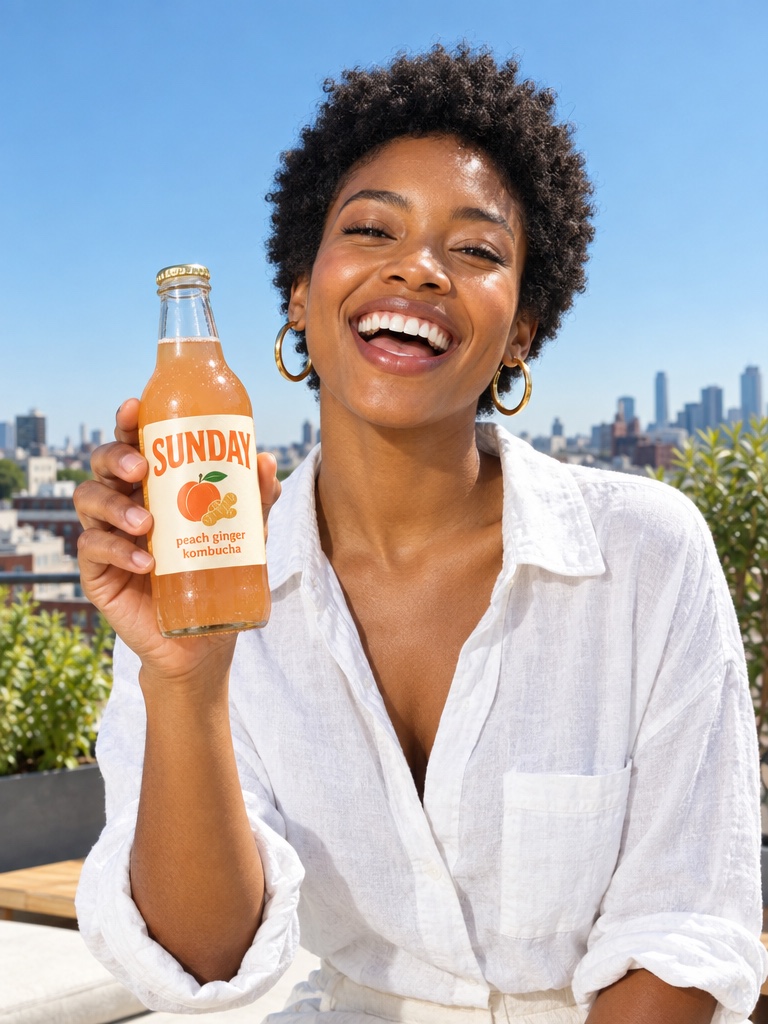
MakeUGC centers the avatar performance. Avocado adds the product layer. When you attach a product, Avocado first edits the creator look with GPT Image 2.5 Flare so the actor holds your real product, then animates that still. The label and packaging start from your reference photos instead of being re-imagined from a prompt.
Brand DNA carries the brand across every run: your products, reference images, visual direction, tone and rules, applied in Studio, Flows and Super Agent. Save a product once and reuse it in images, video and UGC. For product stills, multi-reference editing starts from your real product photos, with Nano Banana 2 Edit taking up to 14 reference images. No model promises a pixel-perfect bottle on every frame, but a campaign of weekly variants that starts from the actual product reads as one brand.
Creator looks, your own look, and voices
Like MakeUGC, Avocado gives you ready creator looks to start from. You can also bring your own look instead of a stock avatar. For the voice, the Talking head engine matches a text-to-speech voice to the creator, and the Audio Studio covers the rest: Fish Audio S2 Pro as the default voice model, ElevenLabs and Seed Audio as alternatives, voice design from a written description, and voice cloning when the brand wants its own voice on voiceovers.
Video models beyond the talking head
MakeUGC optimizes for the talking-head clip. The cinematic pack shot, the stylized 9:16 social motion and the brand film with native audio need different video models.
The Avocado video workbench covers them. Seedance 2.5 handles cinematic b-roll and reference-driven shots, Kling 3.0 covers stylized social motion, Google Veo 3.1 handles brand films with native audio, and MiniMax H3 MAX gives you fast cuts up to 1080p. Start and end frames, animate-a-still and motion control are there when a shot needs direction. The UGC clip lives next to all of it in the same library.
Voice, music, and finishing
MakeUGC includes voice generation tied to its avatar performances and a basic hook editor. For a scripted voiceover that lives between cuts, a music bed that holds the campaign together, and a finished edit, most teams pair MakeUGC with a separate voice app, a music app and an editor.
In Avocado, the Audio Studio adds music beds and sound effects next to the voices, and Director mode in Flows assembles the cut with music on a timeline, working from cast, location and beat references. You choose 9:16, 1:1 or 16:9 when you generate, so each piece already fits its placement.
Flows, a shared canvas you can run again
MakeUGC is mostly single user. Each operator logs in, generates variants, exports.
Avocado Flows is an infinite canvas where you chain prompt, LLM, image, video, music and voice nodes and run every step in one click. Founder, designer and paid acquisition lead work in the same Flow with real-time collaboration and comments, or review it through a public share link. Build a UGC test once, then run it again for the next product, the next angle or the next client. Flows is on every paid plan, and so is the Avocado MCP server, which lets Claude, Codex, Cursor or your own agent use the same tools on the same credits.
On Growth and Pro, Super Agent plans a month of posts in one chat, creates on-brand images, videos and captions, and publishes and schedules them to Instagram, Facebook, TikTok, LinkedIn, Threads and X after your approval. Publishing and Meta Ads need the Connectors add-on.
Pricing
MakeUGC lists Starter, Growth, and Scale plans on its pricing page starting around forty-nine dollars per month, with credits scaling by tier inside the MakeUGC UGC suite (per makeugc.com/pricing, May 2026). Custom plans are available for higher volume.
Avocado starts at EUR 19.99 per month (Intro, 100 credits). Starter is EUR 39 (300 credits) and adds editing, upscaling and Seedance 2.5, Growth is EUR 99 (800 credits, adds Super Agent and team sharing) and Pro is EUR 249 (2,000 credits). One credit balance covers image, video, UGC, music and voice, and every plan includes commercial rights with no watermarks. For a brand running dozens of UGC variants plus cinematic pack shots plus voice plus music, one Avocado plan can replace MakeUGC plus a separate product image tool, a music app and an editor.
What changes in week one
The migration from MakeUGC to Avocado is bigger than a tool swap because the product surface widens. The UGC velocity stays comparable, but every UGC variant can now show the creator holding your real product, and the finished cut comes from the same workspace as the voice and music. Teams usually notice the difference by the third variant set, when the campaign starts reading as one coherent brand rather than a talking head plus a generic product cut.
Honest tradeoff
We will not claim Avocado wins every category. MakeUGC remains a strong dedicated tool for a brand whose entire ad pipeline is talking-head UGC with ready-made hook templates and that wants nothing else in the workspace. That lane is real. What Avocado does is take the lane on the other side, the brand workspace where the UGC clip is one element in a finished ad, the product has to look right when the camera cuts to the bottle, and the team has to ship voice, music and the finished cut from one place.