How do Avocado AI and Synthesia compare feature by feature?
The table lists what each tool ships today, capability by capability. Avocado AI is a full creative workspace; Synthesia is compared on the same rows so the gaps and ties are visible at a glance.
| Capability | Avocado AI | Synthesia |
|---|---|---|
| AI UGC tuned for paid social | UGC studio with product in hand | Corporate presenter avatars |
| Image generation models | GPT Image 2.5, Nano Banana 2, Seedream 5.0, Soul 2 and more | Limited image features |
| Video generation models | Seedance 2.5, Kling 3.0, Veo 3.1, MiniMax H3 and more | Avatar video only |
| Brand DNA and product references | ||
| Music, voice and sound effects | Audio Studio | |
| Voice generation and cloning | Avatar voices | |
| Repeatable workflow canvas | Flows | Workspace sharing |
| AI agent that plans and publishes | Super Agent (Growth and Pro) | |
| Timeline to assemble a cut | Director mode in Flows | Basic editor |
| Commercial rights on every plan | Paid plans | |
| Entry price | EUR 19.99 per month (Intro) | 29 dollars per month |
Synthesia built the corporate avatar lane. The avatar fidelity, the multilingual coverage, and the enterprise compliance posture all suit the training-and-internal-comms use case the product is optimized for. The disagreement is whether a DTC brand shipping paid ad creative should run on a corporate-avatar surface.
A 7-figure DTC brand ad uses a talking-head UGC clip plus a cinematic product hero plus a stylized social cut plus a voiceover plus a music bed plus an assembled cut. Synthesia handles the avatar lane well. The product hero, the cinematic cut, the product-accurate still, and the shared workflow canvas are not its lane.
Avatar performance versus AI UGC
Synthesia is built around presenter-style avatars suited to training videos and internal comms. The performances read as corporate.
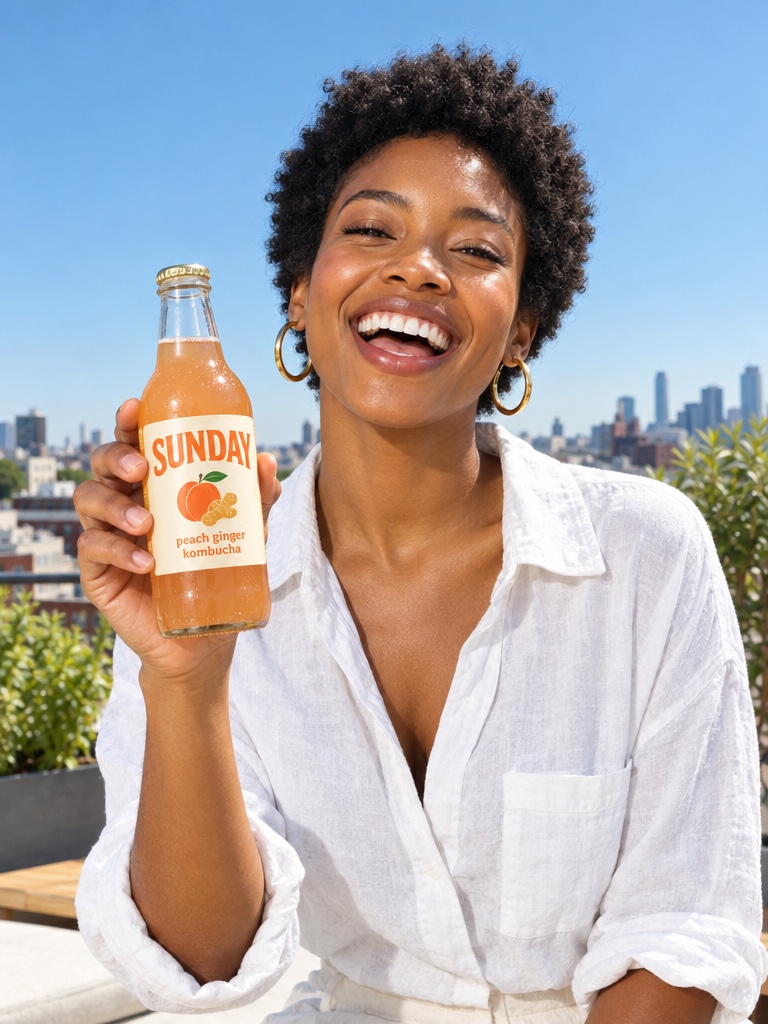
Avocado's UGC studio is built for paid social. You pick a creator look, ready-made or your own, write the script, and get a talking video in 9:16, 1:1 or 16:9, up to 30 seconds. You also pick the engine: Fast UGC with Happy Horse 1.1 as the default, Talking head lip-sync with Fabric plus text to speech, Seedance 2.5 for long-form clips with native audio, or HD UGC on MiniMax H3 MAX Turbo. For a DTC brand running TikTok and Reels ads, a creator-style read matters more than a presenter-style one.
The product in the creator's hand
Synthesia does not work from a brand's real products. The avatar performs the script; any product reference is a stock interpretation.
Avocado keeps your products, references, visual direction, tone and rules in Brand DNA. With a product attached, the UGC studio first edits the creator look with GPT Image 2.5 Flare so the actor holds the real product, then animates the clip. For product stills, you edit from your real product photos with reference-based edit models such as GPT Image 2.5 Flare or Nano Banana 2, so the label and pack stay the product's own. Every UGC variant can cut to an accurate hero still of the same product.
Video models beyond avatars
Synthesia optimizes for the avatar clip. The cinematic pack shot, the stylized 9:16 social motion, and the brand film with native audio need different video models.
Avocado's video workbench includes Seedance 2.5 and Seedance 2.0 for cinematic b-roll, Kling 3.0 for stylized social, Veo 3.1 for brand films with native audio, and MiniMax H3, Grok Imagine Video 1.5, LTX-2 and others. Modes cover text-to-video, animating a still, start and end frames, reference and motion control. The talking-head UGC clip lives in the same library as all of them, on one credit balance.
Voice, music, and assembly
Synthesia includes voice tied to avatar performances and a basic editor. For scripted voiceover, AI music, and the rest of a paid social cut, most Synthesia workflows pair with ElevenLabs, Suno, and a separate editor.
Avocado's Audio Studio covers text to speech with Fish Audio S2 Pro as the default voice model, designing a voice from a description, cloning your voice, music beds from 30 to 300 seconds, and sound effects. Director mode in Flows puts clips on a timeline so you can assemble a cut with music.
Shared canvas and delegation
Synthesia supports workspace sharing for teams. The mental model is shared scripts and avatars.
Avocado runs Flows, an infinite canvas where you chain prompt, LLM, image, video, music and voice nodes and run every step in one click, with real-time collaboration, comments and public share. Founder, designer, and paid acquisition lead can work in the same Flow and run it again for the next product. On Growth and Pro, Super Agent plans content, creates on-brand images, videos, music and captions, and schedules and publishes to Instagram, Facebook, TikTok, LinkedIn, X and Threads after your approval, with publishing on the Connectors add-on.
Pricing
Synthesia lists Starter at twenty-nine dollars per month billed annually, Creator at eighty-nine dollars per month billed annually, plus Enterprise pricing (per synthesia.io/pricing, May 2026). Plans are seat-based with monthly video minute caps.
Avocado plans start at EUR 19.99 per month (Intro, 100 credits). Starter is EUR 39 (300 credits), Growth EUR 99 (800 credits) and Pro EUR 249 (2,000 credits). Studio and Flows are on every plan, with commercial rights and no watermarks, and credits pool across image, video, UGC, music and voice. Super Agent needs Growth or Pro, and publishing plus Meta Ads also need the Connectors add-on.
What teams notice in week one
Teams that move from Synthesia to Avocado are usually changing the entire creative target, not just the workspace. Synthesia produces presenter-style avatars for training; Avocado produces creator-style talking videos for paid social, with the product in hand. The style shift is visible by the first variant: the same script reads as a creator talking about a product rather than a corporate explainer.
The second change is everything around the talking clip. Synthesia covers the avatar lane well. Avocado adds product stills edited from real photos, cinematic pack shots, stylized 9:16 social motion, voice cloning, music beds, and a cut assembled in Director mode. For a DTC brand whose ad creative is talking-head plus product plus motion, the consolidation shows up inside the first weekly cycle.
Pricing in practice
A team running Synthesia for avatars plus a separate image tool plus a video tool plus a music app plus an editor may find one Avocado plan covers the same surface area. A team running Synthesia for corporate training video alone will keep using Synthesia because that lane is different from paid-social ad creative.
Honest tradeoff
Synthesia remains the right tool for corporate avatars, internal comms, training video, and multilingual presenter content where the avatar fidelity and the language coverage are the load-bearing features. That lane is real and Synthesia leads it. Avocado is purpose-built for the other lane: DTC brand ad creative where creator-style UGC with the real product, a choice of video models picked per cut, voice cloning, music and repeatable Flows are the load-bearing requirements. The two products are not actively competing inside the same workflow for most teams.